

Overview
What if Slack understood your company language?
Slackronyms is an imagined feature that gives quick definitions of your company-specific language in sent messages.
Drawing from my own frustration when I join a company and need to learn a new language, this projects aims to reduce the learning curve during onboarding and breaking down external teams siloed language.
Role
Sole designer
Timeline
2 weeks
2024
Tools
Figma
Cursorful
Jitter
1
New message

Clayton
5:10 PM
Thanks for checking out this case study!
Btw
do you have those
TPS
reports ready?
Hover the highlighted words
Problem
Learning the company language is a struggle, even for veteran employees.
That daily communication friction adds up
It's a waste of time and disrupts productivity when you have to hunt down definitions, or awkwardly interrupt a meeting to ask what it means. The problem is the longer an acronyms is used in the workplace, the less often you'll see it spelled out.
My own personal experience feeling lost, confused and building my own Notion dictionary with business lingo made me think there has to be a better approach to communicating company language.
Research
GitHub, Word, and Notion were the most common solutions, but still had friction
Having a dictionary doesn't mean you'll take the time to use it
I interviewed colleagues to reflect on how their workplaces approached this problem. A consistent theme was their organizations didn't want to build a dedicated internal tool or add "another app" to their workflow just to make looking up acronyms easier. The common alternative was building makeshift word banks that felt clunky to use.
INCLUDE SOME KIND OF FLOW OF HOW MY SOLUTION CAN FIX THIS
"In slack -> 1 hover away" "exit task->open the web page or program-> CTRL F-> close application.)
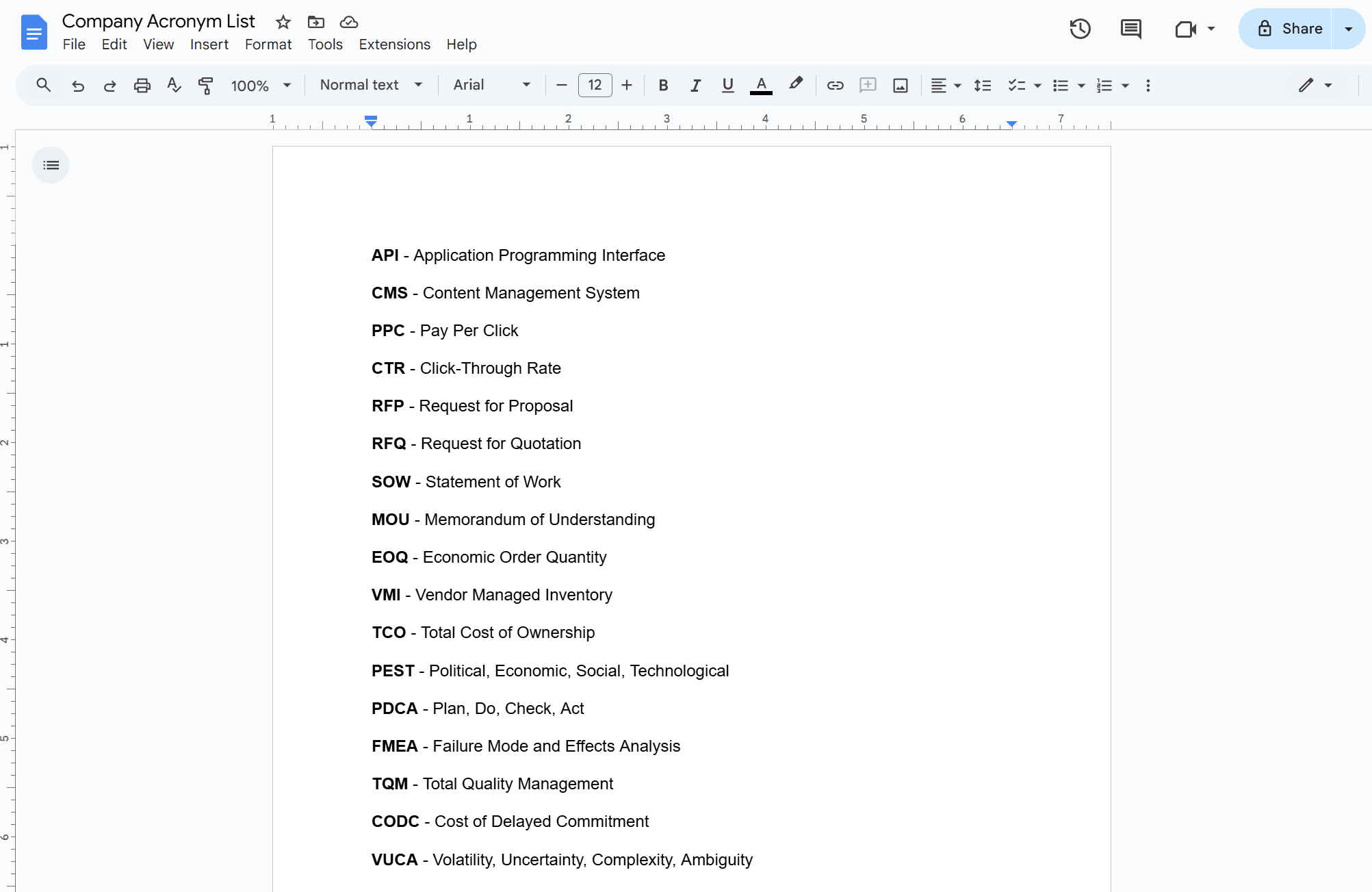
Over time, each platform reaches a breaking point
Needle in a haystack
Locating definitions is tedious. You either scroll through long pages or using a keyword search (Ctrl+F). To store these documents you take up space on your desktop or bookmark bar, it's no better than pulling a dictionary from a shelf. At 50 entries in a doc, fine. At 500+, it becomes impossible to search or navigate. People stop looking things up and just ask around or create their own glossaries.
Difficult to scale
As the organization grows so does the language, there's more opportunities to miss adding new words and keeping old unused ones. What are the rules when adding new acronyms? Without consistent treatment you end up with mixed results how reliable it is.
Lack of ownership and moderation - adding duplicate definitions
Since these documents aren't officially being managed by the company, there is a lack of process and nobody bears responsibility for maintaining them. Without standards upfront, people will format entries differently
Opportunity
With 200k+ organizations already using Slack,
what if we make a new feature for enterprise plans?
With this approach, organizations don't need to adopt to a new tool and Slack gets a unique competitive feature.
Features
Visually spotlighting acronyms the same as @mentions.
@Clayton
AFK
Drawing attention without being too loud.
I wanted to ease users into this feature with recognizable visuals so people would already know they could interact with it the same way they would with an @mention.
Filler text
you decide when to take off the training wheels.
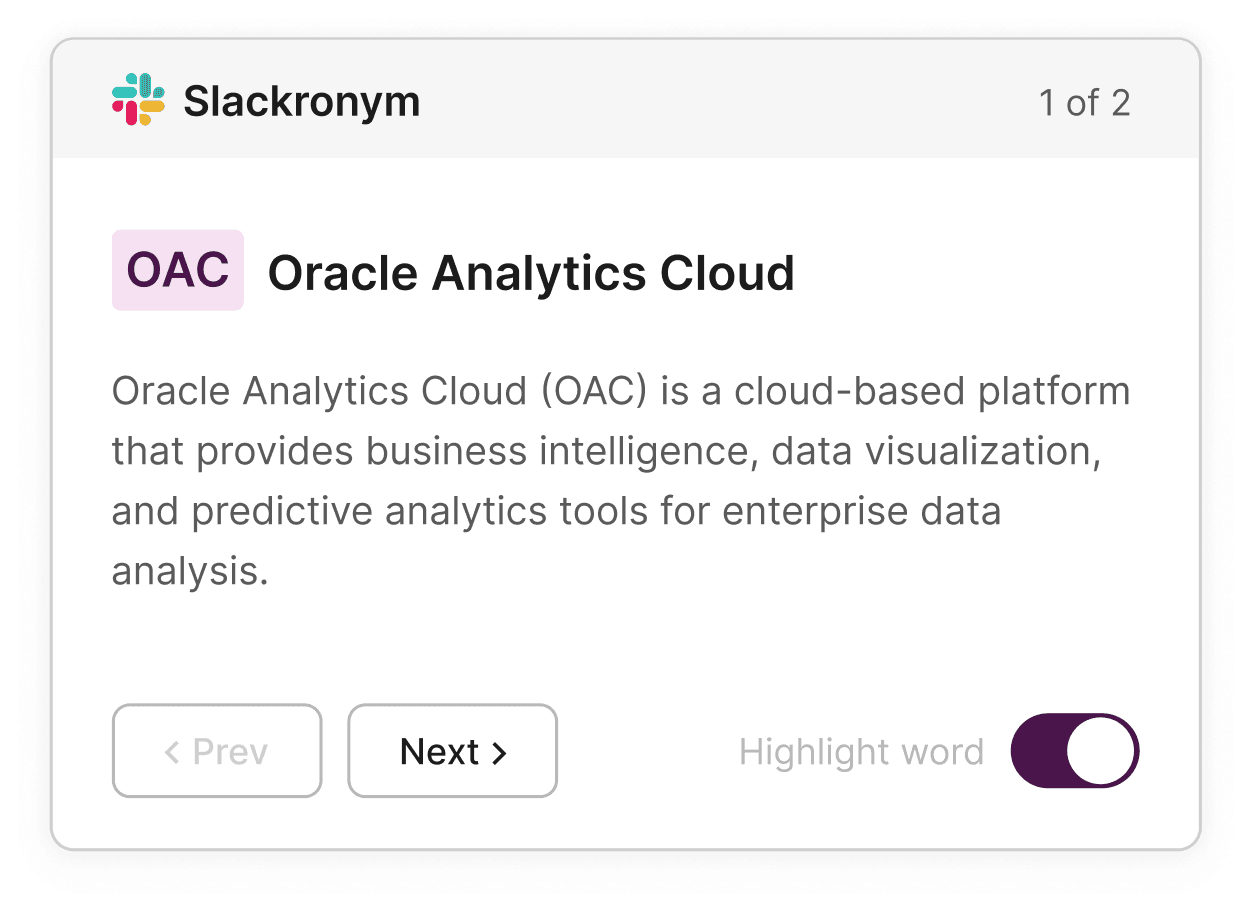
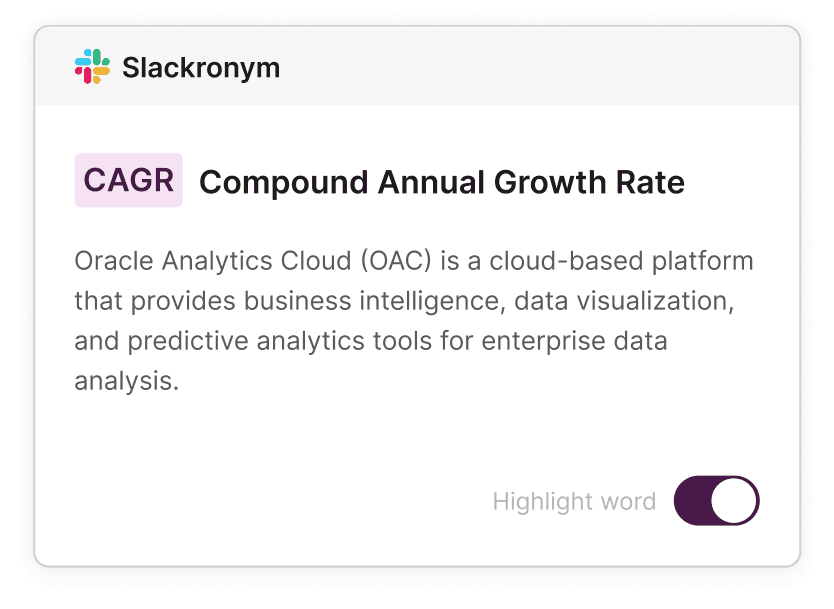
When hovering over a "Slackronym", you can disable highlighting for specific unimportant words and view multiple definitions side by side for acronyms with more than one meaning.
Problem
Manage outdated acronyms and approve new ones.
What makes Slack so appealing is how you can customize your workspace. Slackronyms should feel the same way. With system-admin roles, you can approve new acronyms and enable/disable them across the org.
Over time, each platform reaches a breaking point
Needle in a haystack
Locating definitions is tedious. You either scroll through long pages or using a keyword search (Ctrl+F). To store these documents you take up space on your desktop or bookmark bar, it's no better than pulling a dictionary from a shelf. At 50 entries in a doc, fine. At 500+, it becomes impossible to search or navigate. People stop looking things up and just ask around or create their own glossaries.
Difficult to scale
As the organization grows so does the language, there's more opportunities to miss adding new words and keeping old unused ones. What are the rules when adding new acronyms? Without consistent treatment you end up with mixed results how reliable it is.
Lack of ownership and moderation - adding duplicate definitions
Since these documents aren't officially being managed by the company, there is a lack of process and nobody bears responsibility for maintaining them. Without standards upfront, people will format entries differently
Up next
Teaching Slack your work lingo
I respect you for reading footers
clayding.eh@gmail.com
Clayding.eh@gmail.com
©2026
Clayton Harding
Clayton Harding
Clayton Harding
Work
Work
Work
About
About
About
Play
Play
Play
Friends
Friends
Friends
Resume ↗
Resume
Resume ↗
LinkedIn ↗
LinkedIn ↗